TypeScript Utility Types: A Complete Guide
TypeScript's built-in utility types are powerful tools that help you write cleaner, more maintainable code. In this guide, I'll walk through the most commonly used utility types with practical examples from real-world applications.
',
      description: 'Perfect for update flows where callers only send the fields they want to change.',
      bullets: ['Form patches', 'Update DTOs', 'Feature-flagged config overrides'],
      tone: 'success'
    },
    {
      eyebrow: 'STRICTNESS',
title: 'Required',
description: 'Useful when a loose input shape becomes a guaranteed runtime shape after defaults or validation.',
bullets: ['Normalized config', 'Post-validation objects', 'Internal invariants'],
tone: 'info'
},
{
eyebrow: 'SHAPING',
title: 'PickandOmit',
description: 'The fastest way to carve focused view models and payload types out of larger domain types.',
bullets: ['Preview cards', 'Create/update payloads', 'Public vs internal fields'],
tone: 'warning'
},
{
eyebrow: 'MAPS',
title: 'Record',
description: 'Great for dictionaries, lookup tables, and keyed collections where the value shape is consistent.',
bullets: ['Role maps', 'Route registries', 'Status-to-label maps'],
tone: 'violet'
},
{
eyebrow: 'SAFETY',
title: 'ReadonlyandNonNullable',
description: 'These types help lock down accidental mutation and strip nullable cases after checks or normalization.',
bullets: ['Immutable config objects', 'Derived non-null props', 'Safer shared state'],
tone: 'success'
},
{
eyebrow: 'INFERENCE',
title: 'ReturnTypeandAwaited`',
description: 'Use them to extract shapes from real functions instead of manually duplicating types that will drift.',
bullets: ['Async loader results', 'Factory output types', 'API wrapper return values'],
tone: 'info'
}
]}
/>
Why Utility Types Matter
When building large-scale applications like the ones I work on at Expedia Group, type safety isn't just nice to have — it's essential. Utility types help you derive new types from existing ones without duplication.
Partial<T>
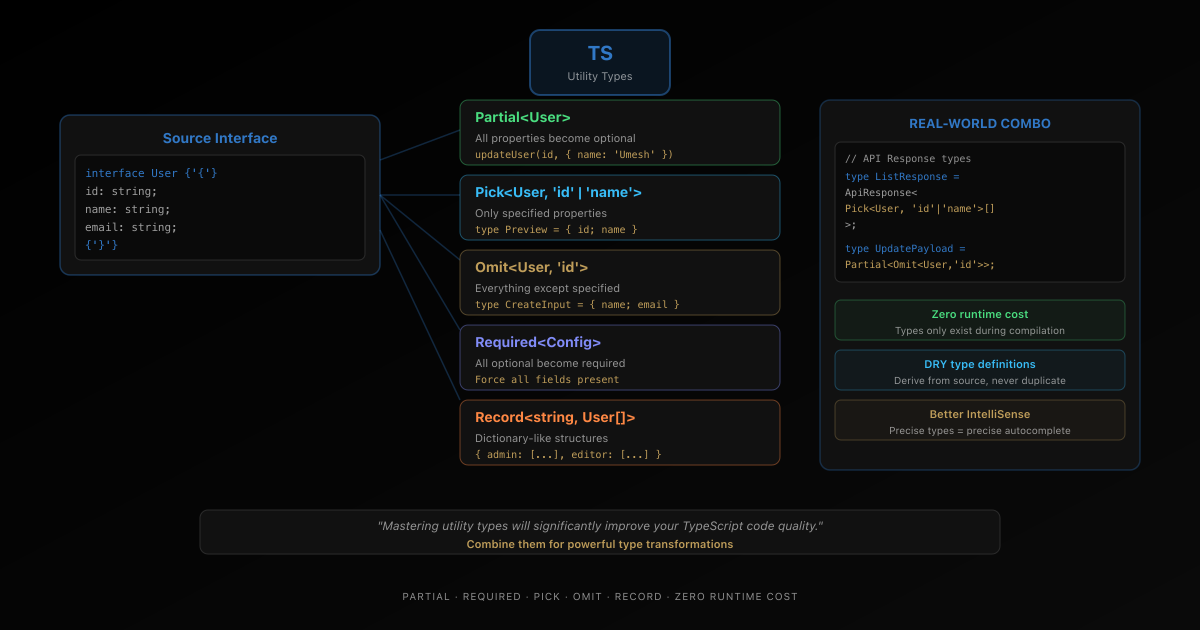
Makes all properties of T optional. This is incredibly useful for update functions.
interface User {
  id: string;
  name: string;
  email: string;
  role: 'admin' | 'user';
}

function updateUser(id: string, updates: Partial) {
  // Only update the fields that were provided
}

updateUser('123', { name: 'Umesh' }); // Valid!
Required<T>
The opposite of Partial — makes all properties required.
interface Config {
  host?: string;
  port?: number;
  debug?: boolean;
}

const defaultConfig: Required = {
  host: 'localhost',
  port: 3000,
  debug: false,
};
Pick<T, K>
Creates a type with only the specified properties.
type UserPreview = Pick;

// Equivalent to:
// { id: string; name: string }
Omit<T, K>
Creates a type excluding the specified properties.
type CreateUserInput = Omit;

// Everything except id
Record<K, T>
Creates a type with keys of type K and values of type T.
type UserRoles = Record<string, User[]>;

const roleMap: UserRoles = {
  admin: [/* admin users */],
  editor: [/* editor users */],
};
Practical Example: API Response Types
Here's how I combine these utility types in real projects:
interface ApiResponse {
  data: T;
  status: number;
  message: string;
}

type UserListResponse = ApiResponse[]>;
type UserUpdatePayload = Partial>;
A Few More Utility Types Worth Knowing
Readonly<T>
Use Readonly when an object should never be mutated after creation.
interface FeatureFlags {
  newSearch: boolean;
  redesignedCheckout: boolean;
}

const flags: Readonly = {
  newSearch: true,
  redesignedCheckout: false,
};
NonNullable<T>
Strip null and undefined once you've validated a value.
type MaybeUser = User | null | undefined;
type SafeUser = NonNullable;
ReturnType<T> and Awaited<T>
Infer the result shape from real functions instead of duplicating it by hand.
async function fetchCurrentUser() {
  return { id: '123', name: 'Umesh', role: 'admin' as const };
}

type FetchCurrentUserResult = Awaited>;
Key Takeaways
- Use
Partialfor update operations where not all fields are required - Use
PickandOmitto create focused types from larger interfaces - Use
Recordfor dictionary-like structures Readonly,NonNullable,ReturnType, andAwaitedcover a lot of everyday type work- Combine utility types for complex transformations
- These types are zero-cost at runtime — they only exist during compilation
Mastering these utility types will significantly improve your TypeScript code quality and developer experience.
Originally published at umesh-malik.com